
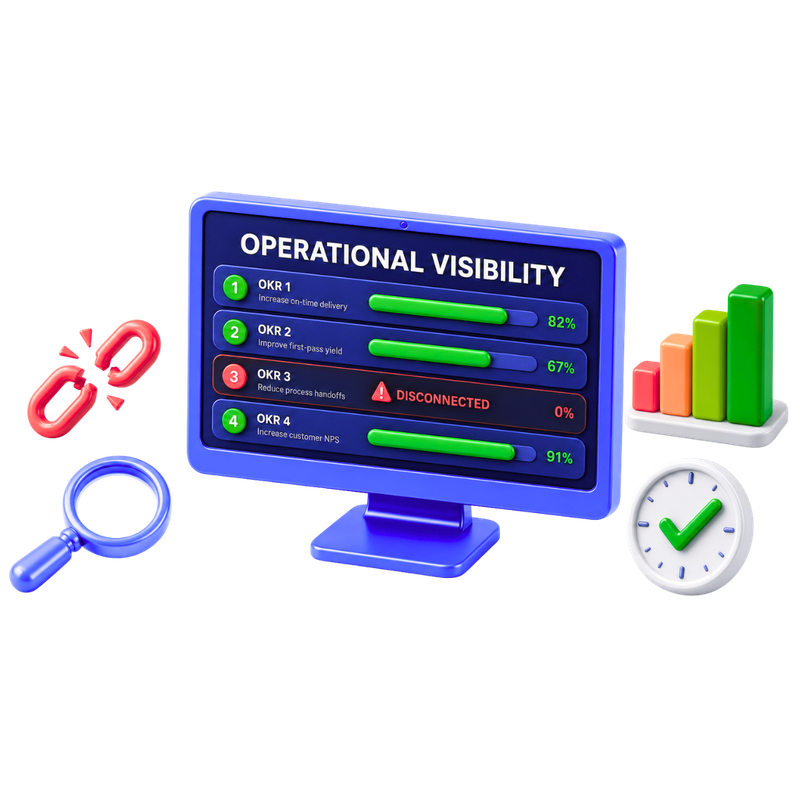
Most leadership teams set OKRs with real conviction. They go through the process, they align on what matters, and they build a dashboard to track it.
Then, three months later, they sit in a review meeting and discover that half the numbers in that dashboard were wrong the whole time.
This isn't a strategy problem, it's a data problem, and it starts well before the review meeting.
The Dashboard Looks Fine. The Data Feeding It Doesn't.
When a CEO looks at an OKR dashboard, they're not looking at reality.
They're looking at a representation of it, one that's only as accurate as the systems feeding it. If your project management tool doesn't talk to your CRM, and your CRM doesn't talk to your finance system, then the numbers your dashboard shows are built on a chain of manual updates, assumptions, and disconnected data.
What usually happens is that each team picks the tools that work best for them. Sales runs on one platform. Operations runs on another. Finance has its own. Over time, the business ends up with a stack of disconnected tools, each doing its job well in isolation, but producing data that can't be reliably combined.
That's where OKR tracking breaks down. Not in the strategy session. In the gap between systems.
Why Progress Updates Are Not the Same as Progress Data
When systems don't talk to each other, someone has to fill the gap. That someone is usually a department head, a project manager, or an ops lead, pulling numbers from three or four different places, reconciling them manually, and presenting a summary in a weekly meeting.
That process introduces two problems that compound over time.
The first is lag. By the time a progress update reaches a leadership dashboard, it's already describing something that happened days or weeks ago.
The second is interpretation. When data has to pass through a person before it reaches a report, it picks up judgment calls along the way. What counts as "on track"? Which tasks get flagged and which don't? Those decisions happen informally, and they add up.
The result is that leaders end up managing off subjective reports rather than actual operational data.
What Connected Operations Actually Look Like
The alternative is making sure your operational systems are integrated well enough that data flows between them without manual intervention.
In practice, that means your project delivery data should reflect in the same place as your resource capacity data. Your sales pipeline should feed into your operational forecasting.
When a project slips, the information should be visible automatically, not because someone noticed and raised it, but because the system registered it.
When that's working, OKR tracking changes character. Instead of reviewing what someone compiled last Thursday, you're looking at what's happening in real-time. You can ask whether a key result is on track and get a real answer, not an approximation.
Three Questions to Test Your Operational Visibility Today
You don't need a full systems audit to get a sense of where your visibility gaps are. Start with these:
When a project goes off track, how do you find out? If the answer is "someone tells me," your data isn't flowing automatically. You're dependent on people noticing and escalating, which means you're also dependent on their judgment about what's worth raising.
How long does it take to compile your weekly ops report? If the answer is more than an hour, manual work is filling a gap that a connected system should be closing. That's time spent on assembly, not analysis.
If one department misses a handover, how quickly does it show up in your OKR dashboard? If it takes more than a day or two, your tracking is retrospective, which means you're always managing slightly behind where you actually are.
What to Do If the Answers Are Uncomfortable
The fix starts with mapping the journey that data takes from where it's created to where it's reported. Walk through how a project update moves from the person doing the work to the dashboard your leadership team reviews. Count the steps. Note where the handovers are manual. That map will show you where your visibility is actually breaking down.
Once you know where the gaps are, you can start closing them, usually with integrations between tools you already own. In most small businesses, the data exists, it just isn't connected.
If you want to map that out with a team that's done it before, that's exactly the kind of conversation we have at mutherboard. Book a 30-minute call and we'll help you figure out where your operational data is falling short of your strategic ambitions.